Jewellery8 min read
TIMELESS STORY OF ROYAL ELEGANCE
A magnificent royal sapphire parure where Victorian heritage meets timeless elegance—deep-blue sapphires framed by brilliant diamonds, crowned by the iconic Belgian Sapphire Tiara and completed with a sentimental sapphire necklace and matching earrings. A masterpiece of royal jewellery history, craftsmanship and enduring beauty.
The Royal Sapphire Parure: A Timeless Story of Diamonds, Sapphires, and Royal Elegance
The jewellery seen in the photograph is one of the most distinctive sapphire-and-diamond combinations associated with Queen Elizabeth II. The set brings together the Belgian Sapphire Tiara, the George VI Victorian Sapphire Necklace and Earrings, creating a coordinated parure of deep-blue sapphires surrounded by brilliant diamonds.
What makes this jewellery particularly fascinating is that it is not simply a matching set created at one time. Instead, it is the result of Victorian-era jewels, a sentimental wedding gift from King George VI, and a later transformation by the royal jewellers. The combination therefore carries several generations of royal history.
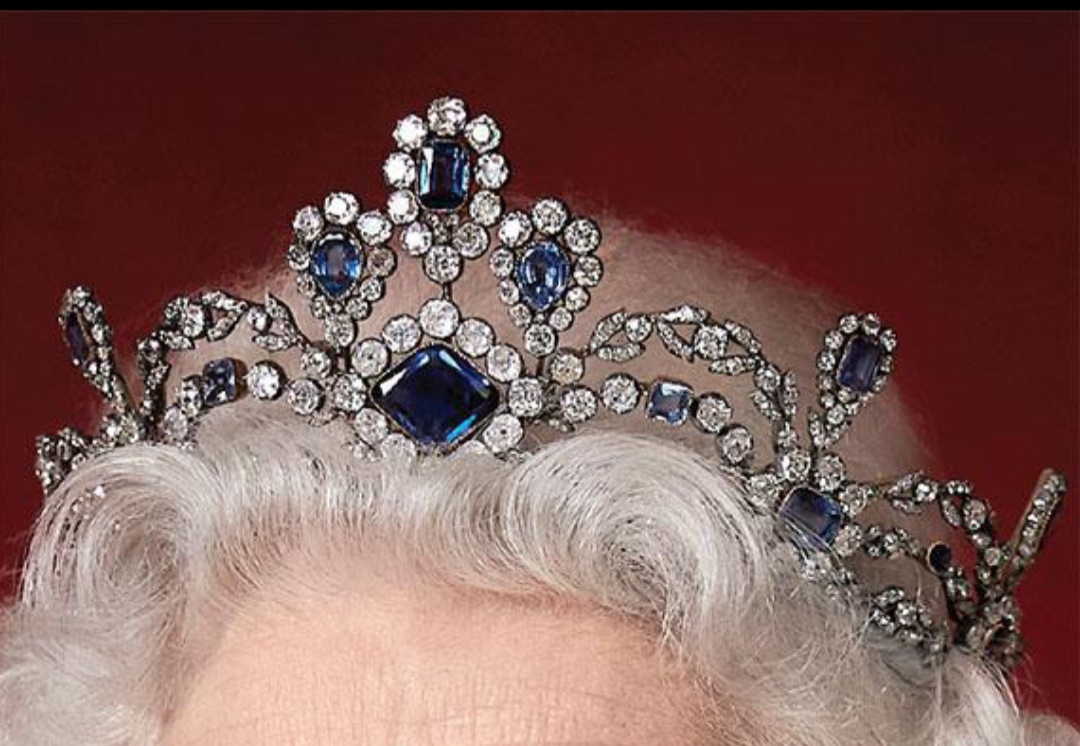
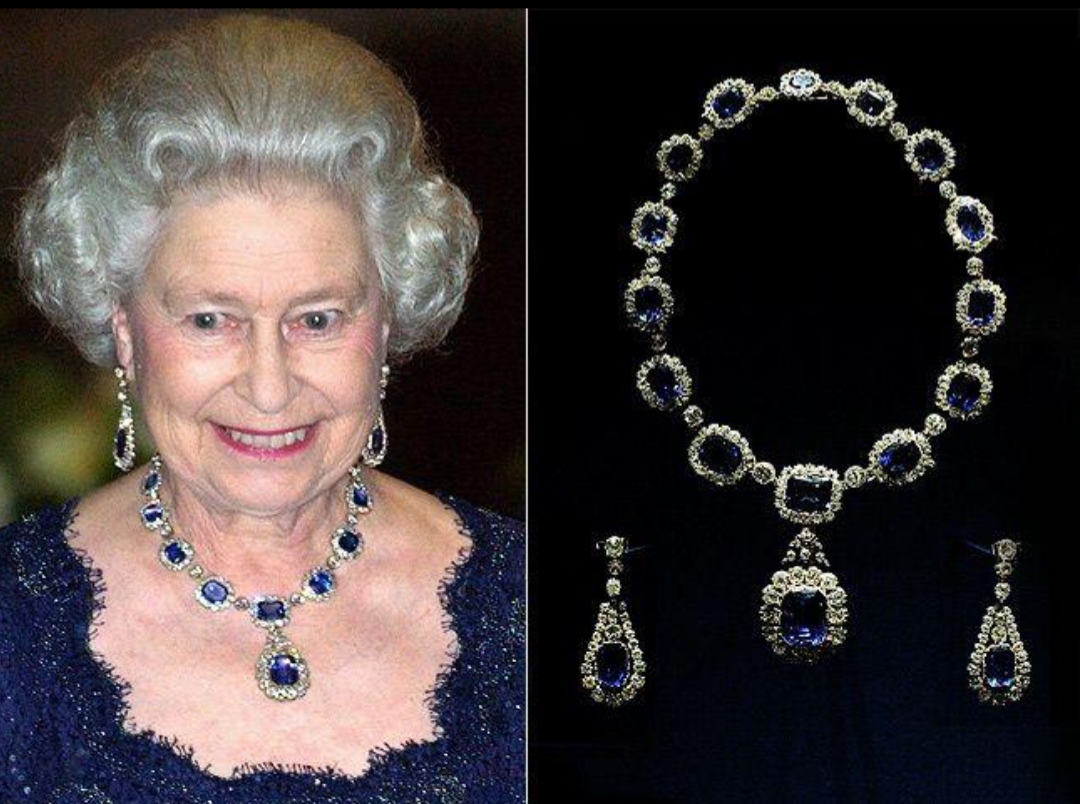
The magnificent ensemble consists principally of a Belgian Sapphire Tiara, a George VI Victorian Sapphire Necklace, and matching sapphire and diamond earrings. A sapphire-and-diamond bracelet belonging to the same overall suite.
The rich blue colour of the sapphires creates a striking contrast against the diamonds. Rather than relying on enormous quantities of gemstones, the design uses repetition, symmetry and strong colour contrast to create its royal appearance.
Diamonds frame the deep-blue sapphires, making the coloured stones appear even more saturated and luminous.
The Belgian Sapphire Tiara
The spectacular headpiece is commonly known as the Belgian Sapphire Tiara, although it is also sometimes referred to as the Victorian Sapphire Tiara or associated with the George VI sapphire suite.
It began life as a 19th-century sapphire and diamond necklace associated with Princess Louise of Belgium. Queen Elizabeth II acquired the jewel in 1963 and had it mounted onto a tiara frame, transforming an antique necklace into the magnificent headpiece seen in photographs.
The original necklace contained articulated sapphire and diamond elements. When converted into a tiara, these elements were arranged vertically and horizontally across a supportive frame.
That gives the finished tiara its characteristic:
- large central sapphire
- diamond borders
- smaller sapphire-and-diamond motifs
- pointed or upright sections
- scrolling and floral-inspired arrangement
- symmetrical silhouette
Garrard is associated with the conversion of the antique jewel into the tiara form. The house describes the present design as being set with twelve prominent blue sapphire clusters on a diamond base.
The George VI Victorian Sapphire Necklace
The necklace seen in the photograph has an equally fascinating history.
It was given to the future Queen Elizabeth II by her father, King George VI, as a wedding gift in 1947.
The necklace and matching earrings were purchased from Carrington & Co. and originated from a mid-19th-century sapphire and diamond suite.
The original necklace was considerably longer.
Historical descriptions indicate that it featured a series of oblong or rectangular sapphires surrounded by diamonds, with diamond-set links between the principal stones.
This gives the necklace a distinctly Victorian character: substantial coloured gemstones arranged within elaborate diamond settings.
The Necklace Was Modified
One of the most interesting things about this royal jewel is that it was changed after Elizabeth received it.
In 1952, the Queen had the necklace shortened by removing its largest sapphire. The removed stone was subsequently transformed into a pendant, which could also be worn as a brooch.
This illustrates an important principle of historic royal jewellery:
- Jewels were not always treated as untouchable museum pieces.
- They could be redesigned to suit changing fashions, personal preferences and different occasions.
- The result was a more adaptable necklace that could be worn with formal evening gowns without overwhelming the neckline.
The Matching Sapphire Earrings
The earrings are an essential part of the visual impact.
They echo the design language of the necklace, combining blue sapphires with diamond surrounds.
The earrings are particularly effective because they frame the face with the same intense blue colour seen in the tiara and necklace.
The eye naturally moves from the blue stones above the forehead, to the earrings beside the face, and finally down to the necklace.
That is why the complete ensemble appears so harmonious.
Why Was the Tiara Added to the Sapphire Set?
When Elizabeth inherited her sapphire necklace and earrings, she did not initially possess a sapphire tiara that perfectly coordinated with them. So, in 1963, she acquired the antique sapphire necklace associated with Princess Louise and had it transformed into a tiara. This effectively created a complete sapphire-and-diamond parure.
This was an extremely clever jewellery decision.
Rather than commissioning a completely modern tiara, an historic jewel was given a new purpose.
The Victorian Connection
The jewellery reflects the taste of the Victorian era, when coloured gemstones were enormously popular in royal and aristocratic jewellery.
Sapphires were particularly fashionable because they offered a dramatic alternative to all-diamond jewellery.
Victorian jewellery frequently incorporated:
- sapphires
- diamonds
- emeralds
- rubies
- pearls
- intricate gold and silver settings
- floral motifs
- symmetrical arrangements
The sapphire parure in this photograph carries many of these characteristics.
A Wedding Gift With Deep Personal Meaning
The necklace and earrings were not merely valuable objects.
They were a father's wedding gift to his daughter.
That gives the jewellery an emotional dimension beyond its gemstone value.
The young Princess Elizabeth received the sapphire pieces in connection with her 1947 marriage to Prince Philip. The fact that she continued to wear them throughout her reign transformed them into visual reminders of her family history.
This is one reason the sapphire suite became particularly important within her jewellery collection.
From Princess to Queen
The jewellery accompanied Elizabeth through different stages of her public life.
As a young princess, the sapphire necklace provided a sophisticated but youthful alternative to heavier ceremonial jewellery.
As Queen, the same stones became part of her formal evening wardrobe.
She wore the sapphire combination for:
- state occasions
- official portraits
- diplomatic events
- receptions
- overseas visits
- formal dinners
- evening appearances
The Belgian Sapphire Tiara was especially prominent from the 1960s onward, although it was later seen less frequently before returning to public view in the 2010s.
A Signature Royal Colour
Blue was an especially successful colour for Elizabeth's jewellery wardrobe.
The sapphire pieces could be worn with:
- white
- silver
- cream
- red
- navy
- black
- royal blue
- pastel colours
Under strong evening lighting, diamonds sparkle intensely while sapphires retain their deep blue colour, making the jewellery highly recognizable in official photographs.
The Design Language of the Tiara
Several details are worth noticing closely.
- Central sapphire: The large central blue stone provides the visual focal point.
- Diamond halo: Diamonds surround and emphasize the sapphire, increasing its apparent size and brilliance.
- Repeated sapphire motifs: Smaller sapphire elements appear along the sides, creating rhythm and symmetry.
- Upright elements: Some of the stones rise above the main horizontal line, giving the tiara height and making it more crown-like.
- Diamond base: The diamond framework provides structural continuity beneath the coloured gemstones.
- Symmetry: Both sides are carefully balanced, creating the formal appearance expected from a royal tiara.
How the Jewellery Enhanced Her Appearance
The jewellery was particularly effective because it did not compete with the face.
Instead, it created a frame around it.
The tiara draws attention upward toward the hair and forehead. The earrings bring the eye toward the face, while the necklace elongates the visual line down toward the neckline.
The result is an elegant vertical composition.
The deep blue stones also provide a dramatic contrast against lighter fabrics, particularly white or ivory evening gowns.
What Makes This Parure Special?
Many jewellery sets are designed and manufactured together.
This one is different.
Its beauty comes from several periods of history being brought together:
19th-century Victorian jewellery↓Princess Louise of Belgium's sapphire necklace↓King George VI's 1947 wedding gift↓Queen Elizabeth II's 1963 tiara conversion↓Decades of royal appearances
That layered history makes the jewellery much more than an attractive collection of gemstones. It is essentially a jewellery timeline.
From Queen Elizabeth II to the Next Generation
The story did not end with Queen Elizabeth II.
After her death in 2022, the sapphire jewels entered the next chapter of their royal history. Queen Camilla subsequently wore the Belgian Sapphire Tiara, demonstrating how historic royal jewellery can continue to be used rather than remaining permanently hidden away.
This is particularly significant because it shows how royal jewellery serves as a form of continuity.
A tiara can outlive its original wearer by generations.
How to Create a Modern Version
The design can be beautifully adapted for today's jewellery market.
A modern interpretation could feature:
- Tiara: A diamond-set platinum or white-gold frame with oval or cushion-cut blue sapphires.
- Necklace: A shorter necklace with graduated sapphire-and-diamond motifs rather than the longer Victorian arrangement.
- Earrings: Pear-shaped or oval sapphire drops surrounded by diamonds.
- Bracelet: A matching articulated bracelet using repeating sapphire clusters.
- Optional pendant: A detachable central sapphire could make the necklace more versatile.
This would retain the royal character while making the jewellery easier to wear with contemporary evening fashion.
The Timeless Appeal of Sapphire and Diamond
The enduring popularity of this jewellery lies in its balance.
- Sapphires provide colour.
- Diamonds provide brilliance.
- The tiara provides grandeur.
- The necklace provides elegance.
- The earrings frame the face.
Together they create an unmistakably regal appearance.
The set demonstrates why sapphire and diamond jewellery has remained popular for generations: it can look historic without appearing old-fashioned.
Final Thoughts
The jewellery shown in the photograph represents one of the most beautiful examples of royal sapphire styling: an antique tiara created from a historic necklace, paired with a sentimental Victorian sapphire necklace and matching earrings given as a wedding gift.
Its greatest beauty is not simply in the size or number of its gemstones. It lies in the history carried by each piece.
From 19th-century aristocratic jewellery to a 1947 royal wedding gift and the later transformation of an antique necklace into a tiara, every element tells a different chapter of the story.
It is a perfect illustration of how exceptional jewellery can become more than an accessory. It becomes heritage, memory, craftsmanship and identity—preserved in gemstones and passed from one generation to the next.